A tale of two interviews
Kristen Welker grills the president, and Scott Pelley defends himself. What did we learn?

By Dave Helling
Two videotaped interviews made the news over the weekend. Let’s take a look!

Kristen Welker interviewed President Donald Trump for Meet the Press. She met him in Wisconsin.
The interview was more performative than informative, which they always are. No one truly expects Trump to break down and admit his policy errors, misleading statements, or misbegotten decisions in an interview. No one expected an Epstein confession.
We know the president to be liar. We know he doesn’t understand how government works. We know he will make outrageous claims unmoored to evidence or facts. That’s his schtick.
But interviews like Welker’s are still valuable, fascinating events, particularly when taped and televised, as this one was. It’s important to see the president turn colors when pushed in the slightest by an interviewer.
(A single interviewer, not shouted questions at a rope line, with helicopter noise in the background, yields better results.)
Trump’s only reaction — deny, obfuscate, interrupt, lie — suggest the president himself knows he’s all crust and no cheese. Stomping off the set at the end reflects this self-knowledge: he’s getting nothing from this exchange, so he takes his ball and goes home.
It also shows how little pushback he gets from the people around him. If you’ve ever watched the sickening spectacle of Trump-worship at a cabinet meeting, you know how unprepared the president is for even a slight nudge from the press.
That was Welker’s success. She was prepared, firm, unintimidated — yet never rude or self-centered. She knew, as reporters know, that her subject would evade direct answers — that’s normal in political interviews.
But she also knew he would turn the interview into a personal confrontation, accusing her of being “crooked,” which may one of the biggest self-owns of all time, broadcast for all to see.
Sitting in a barn in Wisconsin, the president became unhinged.
Early in my career, at the age of 24, I was offered an opportunity for a one-on-one interview with Sen. Ted Kennedy, who was then running for president against Jimmy Carter. I prepared for the brief interview with notes, prepared questions, the works.
Kennedy ate me up. I was intimidated by his Kennedy-ness, and too focused on my own agenda. I learned an important lesson that day, which is: rote preparation is less important than actually listening to answers. Oh, and that politicians are not gods.
Kristen Welker was not intimdated. As a result, we got an important look at a disintegrating Donald Trump.
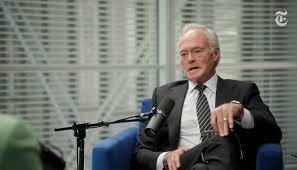
The New York Times taped and transcribed an interview with Scott Pelley, the CBS reporter who was fired last week after hammering new leadership at 60 Minutes, the program where he worked.
The interview clearly revealed Pelley’s deep investment in his work, and his despair at the changes at 60 Minutes, and CBS News in general. He supported the show’s staff for a reason: anyone who has ever worked in TV news knows most of 60 Minutes reflects the work of producers and editors, not just correspondents like Pelley.
Newsrooms are fascinating places. Everyone in a newsroom is expected to think and act with independence and focus (and, sometimes, aggression.) Successful newsrooms are collaborative and non-hierarchical, not top-down dictatorships.
At the same time, someone has to call the shots — who’s on the front page, who leads the newscast, who goes where and does what when news breaks. Otherwise, it’s chaos.
So there’s a typical tension between reporters and editors who like to think for themselves, and newsroom supervisors who sometimes have different ideas. The best newsrooms understand that tension and use it to produce better stories.
Sometimes, though, the folks at the top have a fundamentally different outlook than the reporters on the streets. That seems to have been the case at 60 Minutes, for Scott Pelley.
When that happens the only real choice is to leave, which Pelley seems to have understood as well. No newsroom employee launches into the broadside Pelley used against new management and expects to survive in the job for very long.
Pelley used the New York Times interview to explain his outbursts, and to suggest he wasn’t aware of the damage they would cause. But I’m pretty certain any newsroom veteran knows that Pelley’s language, right or wrong, was the beginning of the end.
CBS News’ reputation, earned over decades, is in tatters, of course. It’s clear the owners of the network think the newsroom needs some kind of ideological reset — which sucks, and won’t work, and is anti-Constitutional and scary, but which is also their decision to make.
I’ve worked for crappy news directors, too. (Not, though, at the Kansas City Star, which, for all its bad business decisions, remained committed to high quality reporting during my time there, and still does today.)
It’s one of the first lessons of journalism, and television news: No one is irreplacable.
Well said, Dave. I haven’t seen Scott Pelley’s interview, but I did see Kristen Welker. She was certainly the adult in the room!
Hmmm. I read your columns in hope of spying any hint of self awareness from your left handed perspective but alas, I was disappointed again.
I’ll be interested to read what you write if you review Jill Biden’s new book. Certainly, the self-adoration exhibited by Trump’s cabinet is minor league compared to the doo-wap band Biden had around him in the fateful last days of his term. A band led by Jill Biden who continues the charade in her new book.
The point is, your perspective on these events would be so much more valuable if you just opened your lens just a tick or two wider.